BREAST FEEDING -A TECHNIQUE
Breast feeding is an art that a new born mother should master in the post-natal period for a successful and self-efficient breastfeeding. According to the WHO guidelines a new born should be exclusively given breast milk for 6 months followed by supplementary nutrition up to 2 years of age or more.
- Breast feeding should be initiated within the first hour of life.
- It should be done as and when the baby demands during the day as well as during night.
- Use of bottles or pacifiers should be avoided.
- In primigravidas (first time mothers) milk ejection may take upto 72 hours.
- It is essential that the breastfeeding woman wears a bra immediately from the second day if delivery.
- The bra should always be one size larger which does not obstruct the milk flow and cause congestion.
Breast feeding works on the let down reflex. This happens when the baby sucks the nipple, signals are sent to the hypothalamus and pituitary which causes release of oxytocin in the blood which helps in milk ejection. Let down reflex can also occur even if the mother thinks of the baby or even hears his voice.
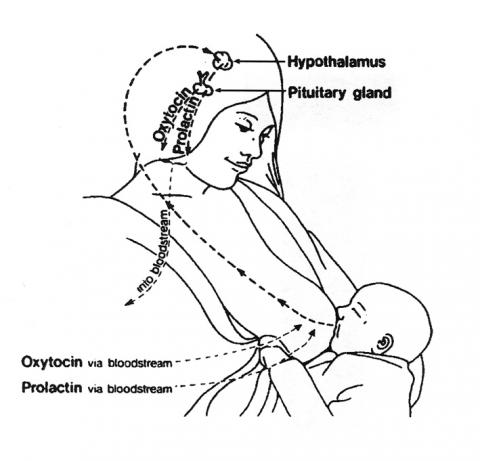
Breast milk composition: –
First two days after delivery, the secretion from breasts is called colostrum which is deep yellow in colour and high in vitamin A, protein, sodium and chloride and has low carbohydrate content. It contains antibody IgA.
| Protein | fat | carbohydrate | Water | |
| Colostrum | 8.6 | 2.3 | 3.2 | 86 |
| Breast milk | 1.2 | 3.2 | 7.5 | 87 |
Advantages of breast feeding: –
- Ideal composition for easy digestion
- Rich in lactalbumin and lactglobulin and less in casein so easily digestible
- It contains vitamin D which protects against rickets
- Lactoferrin, lysozyme, lactoperioxidase prevents growth of E.coli thereby preventing gastroenteritis
- Contains antibody IgA
- Breast feeding acts as a natural contraception
- Psychologic benefit to mother child relationship
- Helps in involution of uterus
Technique: –
Breast feeding can be done in various positions. But before that we need to be aware about the basic ergonomics to be followed while breast feeding.
- Always sit with an erect back which is supported.
- Pillows on your lap
- Maintain skin to skin contact.
- Support your breast by making a ‘C’ shape of your hand and not to squeeze between two fingers.
- Do not breast feed by bending down from your back.
Different positions for breast feeding are –
- cradle
- cross cradle
- football
- sidelying
- inverted sidelying
- Australian hold
- Back lying

Good vs bad latch: –
Always make sure that the baby has latched on properly to avoid sore cracked nipples.
Check your nipples post breast feeding: The nipples should look same as before if the baby has latched properly.

The picture above shows us a good and a bad latch.
Signs to look for a good attachment are:
- Chin is pressed over the breast.
- Low lip is flanged or turned out over the breast
- Much of the areola should be in the baby’s mouth
- No pain
- Whole jaw movement of the baby can be seen while sucking
While breast feeding make sure that you feed the baby completely from 1 breast and then the rather than shuffling from 1 breast to another.
This helps in maintaining the satiety of the child. As while breast feeding there is a concept of foremilk and hindmilk. Foremilk helps to quench the baby’s thirst, high in lactose and protein and not high in calories or fat. Whereas hind milk is thick, high in calories and comes towards the end.
Sometimes it may happen that milk production and milk consumed by the baby does not match leading to breast engorgement. This should be taken care of immediately. Different ways of managing engorgement are-
- Icepacks
- Cabbage leaves
- Manual massage
- Expressing the milk in clean containers at regular intervals
- Breast pump
- Physiotherapy
Physiotherapists plays a major role in the immediate period post-delivery-
To teach the correct technique
Make the female aware of different positions
Look for breast engorgement
Teach manual massage to reduce engorgement
Manual expression of milk
Use of breast pump
Also, to inspect whether the nipples are retracted, cracked, sore and advise them the use of nipple shields.
Thus, by learning and becoming aware of these few techniques of breast feeding we can ease a mother’s journey with the new born and help the new born get the right nutrition.

 drmithila's blog